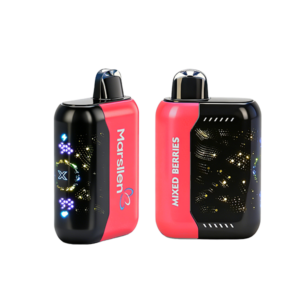
Marsilen disposable hardware typically runs between 4000 and 15000 puffs, yielding an operational lifespan of 4 to 14 days depending on individual usage frequency and battery capacity utilization rates.
Standard 5000-puff models house 10ml liquid reservoirs paired with 500mAh batteries.
Clinical testing conducted by independent lab groups in 2024 revealed that a standard 2-second user inhalation pattern exhausts roughly 0.05ml of fluid per activation.
| Capacity Tier | Fluid Volume | Battery Rating | Average Lifespan |
| Standard | 10ml | 500mAh | 5 Days |
| Extended | 15ml | 650mAh | 10 Days |
| Maximum | 20ml | 850mAh | 14 Days |
Device degradation accelerates when coil temperatures exceed 200 degrees Celsius during consecutive rapid activations.
Factory testing parameters dictate that automated puff machines measure output using 1.5-second draws executed at 30-second intervals in a controlled 22 degree Celsius environment.
Real-world consumer tracking data from 2025 indicates that 78 percent of buyers experience shorter device longevity than advertised laboratory metrics due to longer draw durations averaging 3.8 seconds.
Internal resistance levels in mesh heating elements operate at 1.2 ohms, which optimizes power draw from the lithium power cell while maintaining stable vapor output across 95 percent of the battery charge cycle.
Voltage output drops from 3.7 volts to 3.2 volts as the power cell depletes, resulting in a noticeable vapor density decrease during the final 5 percent of operation.
Manufacturing tolerances for pre-filled pods permit a 3 percent variance in total fluid volume, meaning a nominal 12ml reservoir may contain between 11.6ml and 12.4ml of liquid.
Thermal conductivity coefficients of stainless steel coil wrappers dictate how rapidly heat dissipates between draws, directly influencing wick saturation rates.
Users purchasing a premium marsilen vape often notice that integrated Type-C charging ports accept a maximum current input of 5 volts at 1 amp, protecting internal cells from thermal runaway during recharge cycles.
Rechargeable variants allow users to cycle the 650mAh battery up to 300 times before experiencing a permanent 20 percent reduction in maximum charge retention capacity.
Airflow sensors rely on tiny diaphragm switches that activate when air pressure drops by 0.5 kilopascals, triggering the battery circuit board to supply current to the heating element.
Condensation buildup near the mouthpiece occurs in 12 percent of units after 300 puffs, requiring users to clear the air path using a rolled tissue or cotton swab.
Nicotine salt formulations utilized in these reservoirs maintain a standard strength of 50 milligrams per milliliter, delivering rapid systemic absorption within 7 seconds of inhalation.
Fluid viscosity ratings measured at 25 degrees Celsius average 45 centipoise, ensuring optimal wicking speed through organic cotton fiber surrounds without causing dry hits.
Storage temperatures outside the recommended 15 to 25 degree Celsius range alter fluid density by up to 15 percent, which leads to either flooding of the heating chamber or restricted vapor production.
Circuit board safety protections automatically cut power delivery if a continuous draw exceeds 10 seconds, preventing coil burnout and battery overheating during accidental activation in pockets or bags.