The practical difference between OEM and ODM is who owns the formula and who carries the development work. In an OEM arrangement the brand brings the formula and the factory manufactures it; in an ODM arrangement the factory develops the scent, usually from an existing library or a new brief, and the brand selects. Most real projects sit between the two. The first call goes better when the brand knows which parts of the work it intends to own and which it wants the factory to carry.
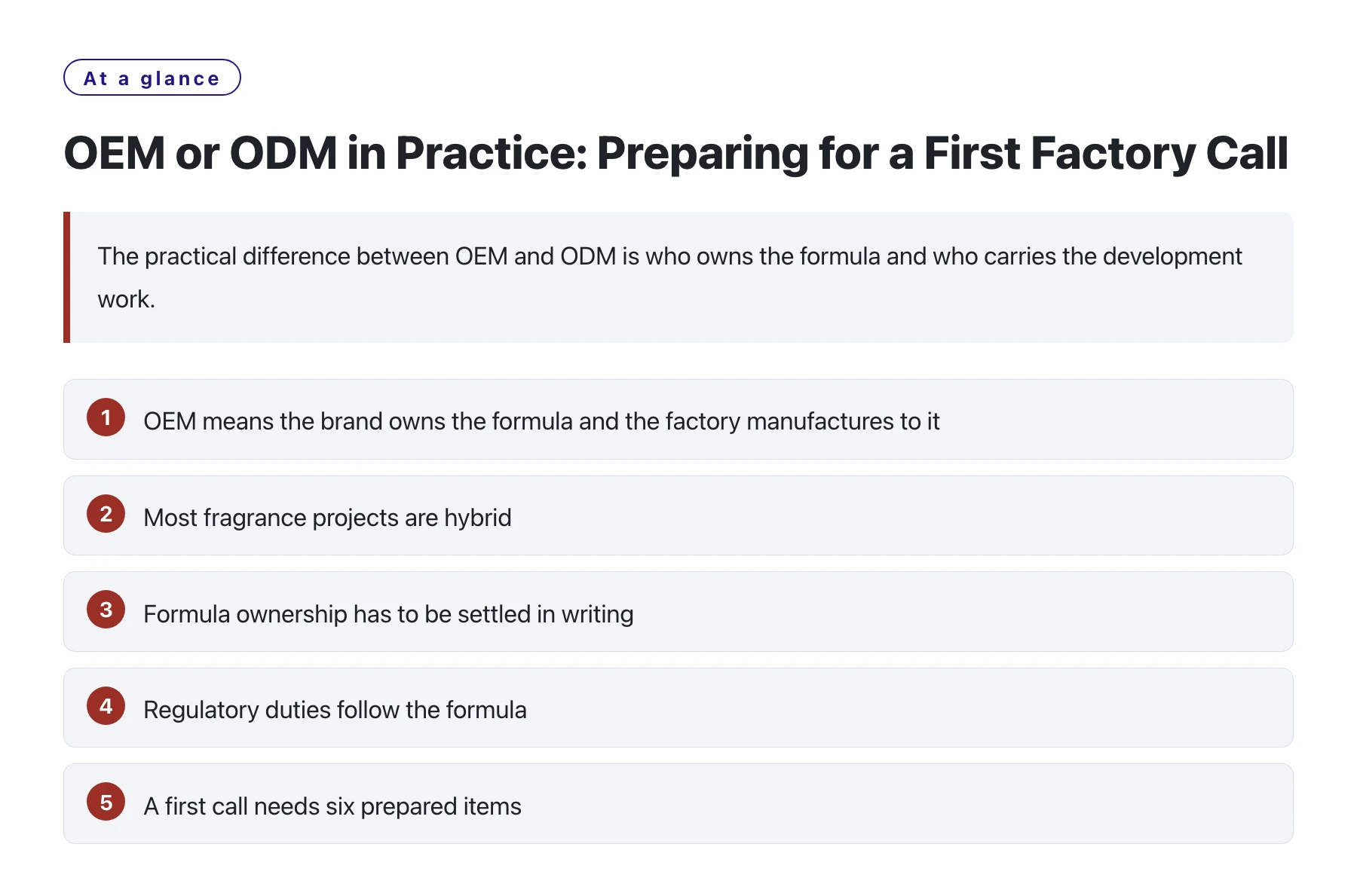
Key takeawaysOEM means the brand owns the formula and the factory manufactures to it; ODM means the factory develops and the brand selects. · Most fragrance projects are hybrid, so the useful question is which specific steps the brand will own. · Formula ownership has to be settled in writing, including what happens to the formula if the relationship ends. · Regulatory duties follow the formula, so the ownership decision shapes who prepares which documents [1]. · A first call needs six prepared items; arriving without them usually produces a second call rather than a quote.
Ask ten suppliers to explain the difference between OEM and ODM and you will get ten variations, because the terms describe the ends of a spectrum rather than two sealed products. What matters commercially is not the label but the answer to one question: who develops the formula, and who owns it afterwards?
That question determines the timeline, the cost structure, the documentation duties and the brand's ability to move production later. It also determines what the factory needs from the brand. A brand that intends to bring its own formula has one set of preparation tasks; a brand that wants the factory to propose scents has another.
This guide separates the two models as they appear in practice, then sets out what to prepare before the first call, with a Middle East launch as the working example.
The difference that matters is who owns the formula
In an OEM project, the brand arrives with a formula or a fully specified direction and the factory's job is to manufacture it consistently, at the agreed fill, in the agreed packaging, with the agreed documentation. The development risk sits with the brand, and so does the ownership of the formula, provided that is written into the agreement.
In an ODM project, the factory develops the scent, either by adapting something from its library or by working from a brief. The brand evaluates and selects. Development risk sits with the factory, which is why ODM work is often faster to first sample and why the resulting formula may belong to the factory rather than the brand.
The ownership sentence is the one that causes problems years later. If the brand assumes it owns the formula and the contract says otherwise, moving to a second manufacturer means starting again. Settling it in the first conversation costs nothing and prevents the most expensive outcome in this category.
The overlap is where most projects live. A brand may own the direction and the approval, while the factory owns the compounding know-how and the specification. That is a legitimate arrangement; it just needs to be described precisely rather than left to the word ODM. Working with a partner whose fragrance OEM/ODM services span development and production makes that hybrid easier to structure, because the same team holds both halves of the file.
What the two models ask of the brand
An OEM project asks for a complete technical brief: formula or reference, concentrate load, carrier, target fill, packaging specification and the documentation the brand will supply. The factory's questions are mostly about repeatability.
An ODM project asks for a commercial and sensory brief: who the product is for, where it will be sold, the price point, the wear or throw expected, and the brand's references. The factory's questions are mostly about direction. Brands that arrive with technical data for an ODM conversation, or with mood boards for an OEM conversation, usually spend the first call translating.
A shared material vocabulary helps in both cases. Public material references make it possible to check what a named ingredient actually is, and how it is normally used, before a conversation about substitutions begins [3]. That is a small amount of preparation with a disproportionate effect on how quickly a brief becomes a formula.
OEM and ODM side by side, and what to bring
| Dimension | OEM in practice | ODM in practice | Prepare before the call |
|---|---|---|---|
| Formula source | Supplied by the brand or specified in full | Developed by the factory from a brief or its library | A decision on which route you are asking about, stated plainly |
| Development risk | Carried by the brand | Carried by the factory | Your tolerance for sample rounds and your approval criteria |
| Typical first sample | A manufacturing trial of an existing formula | A direction, often one of several | Whether you want one sample or a set of directions |
| Ownership | Usually the brand, if written into the agreement | Usually the factory, unless exclusivity is negotiated | A written position on ownership and exclusivity |
| Cost structure | Development is light; production and materials dominate | Development is built into the service, sometimes as a fee | Target unit cost and the volume it assumes |
| Documentation | Brand supplies formula data; factory supplies batch records | Factory supplies material data and formula documentation | Which market you are entering and who files what |
| Best fit | Brands with a formula or a perfumer of their own | Brands that want a scent developed and a partner to run with it | A one-line description of what your team can and cannot do in house |
The table describes the extremes. The pragmatic middle, and where a large share of projects sit, is an ODM-developed scent that the brand licenses or owns outright after a development fee. If that is the arrangement you want, say so at the start rather than after the sample is approved, because the commercial terms are different and they are much easier to agree before the work exists.
Six things to prepare before the first call
- The market and channelDestination countries, sales channel and the price point the product must sell at. This single item shapes every subsequent recommendation the factory makes.
- The wear or performance targetFor fine fragrance, describe the expected presence at hour four; for home fragrance, describe the throw and the room size. Vague words like strong or long lasting produce a vague direction.
- Your referencesThree to five fragrances you admire, with a note on what specifically you admire about each. References are the fastest way to communicate a direction, provided the note explains the reason.
- The format and packaging positionBottle family, decoration level and whether packaging sourcing is in scope. If the answer is undecided, say so and ask what the minimum commitment looks like.
- Volume and unit costA realistic first order quantity and a target unit cost the price point can support. Factory advice is only useful against a number, even an approximate one.
- Ownership and exclusivityEither a position or an explicit question. Ask who owns the formula, whether it can be used for another brand, and what the terms are if the brand later moves production.
How the choice changes the timeline and the file
OEM work tends to have a shorter development phase and a longer qualification phase, because the brand's formula still has to be trialled and released against the brand's own specification. ODM work inverts that: the development phase is longer, because the direction has to be established and evaluated, while the qualification phase is shorter because the factory already owns the specification.
The documentation duties also shift. In both models the factory supplies material data and batch records, and the brand confirms the market requirements, but the party that holds the formula usually holds most of the technical file. Restricted material allowances and use limits are part of that file, and the standards programme behind them applies to the finished product regardless of who developed it [1]. The safe use framework published by the industry association explains how those limits are organised by product type and exposure [2].
For a Middle East launch there is one additional consideration. Presentation standards and warm-climate wear expectations mean the brief carries more weight than usual, so the model that gives the brand more control over the sensory direction, which is usually ODM with a bespoke element, is worth considering even when a library scent would be faster.
What a good first call looks like
A useful first call produces four things: a restatement of the brief in the factory's words, a view on which model fits the work, an indicative cost range with its assumptions, and a list of what the factory needs next. If the call produces only enthusiasm, the preparation was not used.
It also helps to ask about the sequence rather than the outcome. A partner that can describe the stages of development, and where the decisions fall, is describing a system. That is the meaning of fragrance manufacturing under one roof in practice: one team accountable for the stages rather than a handover between vendors, which reduces the number of places where a brief can drift.
Reading what one-stop scent development covers before the call is a reasonable way to prepare the sequencing questions, particularly on where sampling ends and production qualification begins.
One question decides more than any other in the first call: who owns the formula when the project is over. Ask it plainly, get the answer in writing, and check that the answer also covers what happens if another brand asks for something similar. Everything else about OEM and ODM can be adjusted later; ownership is the term that determines whether the brand or the factory holds the leverage.
Choosing between them without overthinking it
If the brand has a perfumer and a formula, use an OEM arrangement and put the effort into specification and qualification. If the brand has a clear commercial idea and no formula, use an ODM arrangement and put the effort into the brief, the references and the ownership terms.
If the brand has neither, which is common at a first launch, the most efficient route is usually ODM with a bespoke hero and selected library scents for the rest. It keeps the direction under the brand's control where it matters and uses the factory's existing work where it does not.
Whatever the route, the preparation list does not change. The six items above are what any competent factory will ask for, and arriving with them is the difference between a first call that produces a plan and a first call that produces a request for more information.
Sources
- IFRA Standards Library (International Fragrance Association) —— The IFRA Standards Library lists the restrictions the fragrance industry applies to individual fragrance ingredients, based on safety assessments; it is the reference point for compliant fragrance formulation.
- IFRA: Safe Use and Fragrance Science —— IFRA's explanation of how fragrance materials are scientifically assessed for safe use and how those conclusions are applied by the industry.
- The Good Scents Company —— A reference database of aroma materials with odour descriptions, CAS numbers and typical usage information.
Frequently asked questions
Does ODM mean the brand does not own the scent?
Not always, but it often does by default. Ownership depends on the agreement, not on the label. Some factories transfer ownership after a development fee, some grant exclusivity for a period, and some retain the formula. Ask directly and have the answer recorded in the contract.
Which is cheaper, OEM or ODM?
The headline cost differs more in structure than in total. OEM development is light because the brand supplies the formula, while ODM development may carry a fee or be built into the service. Compare total landed cost at the same volume and scope, including any development or exclusivity payment.
Which model is faster to a first sample?
ODM usually reaches a first sample faster when a library scent is a good fit, because development starts from existing work. OEM can also be quick if the formula is complete and the trial is straightforward, but qualification usually takes longer because the brand's specification has to be verified.
Can a project switch between OEM and ODM halfway through?
In practice, yes, and many do. A brand may start with an ODM direction and later take ownership of the formula, or bring its own perfumer in after an initial round. The switch is much easier if ownership and next steps were defined at the start, before samples existed.
What should a brand ask about exclusivity?
Ask whether the same formula is offered to other brands, in which markets, and for how long the restriction applies. Also ask what happens to the packaging tooling and the specification if the relationship ends, since those determine how quickly the brand could move production.