How Sex AI Companions Adapt to Your Personality
Personalisation in adult AI chat is a feedback loop rather than a personality test, and the loop is fed entirely by what you write. Crushon's own description of the feature is modest and worth reading literally: it says a companion "adapts to your personality, remembers your preferences", and that characters recall previous interactions and change over time. Nothing in that sentence promises a mind reader, and nothing in it is hard to use well.

Key takeaways
- The loop has three parts: the detail you supply, what is retained between sessions, and the reply that reflects it.
- Adaptation is text-level only — the platform states its content is AI-generated text and depicts no real person.
- Consistency beats intensity: 16 sessions a month at 30 minutes each is 8 hours of signal, not 8 hours of one message.
- Vague input produces generic output, because there is nothing in the loop to reflect.
Where the personalisation signal comes from
Crushon labels these characters Sex AI companions, and the label is a useful description of scope: a companion that exists as text, not as a person. A companion has three sources of information about you: the character you picked, the messages you have already sent in that conversation, and the preferences the platform retains so later replies can take them into account. None of those three is a psychological profile. Together they behave more like a set of instructions that gets sharper each time you restate what you want.
That distinction matters because it changes what good usage looks like. If adaptation were a hidden profile, the best tactic would be to say nothing and let the system work. Since it is instruction-following over retained context, the best tactic is the opposite: say the relevant thing early, say it plainly, and keep saying it in the same way so the pattern is easy to hold.
What improves quickly and what improves slowly
Short-horizon elements improve in a single session. Register, pacing, the length of a reply, whether the character is the one asking questions — all of these respond to how you write in the first few exchanges. If a conversation opens in a tone you dislike, the correction usually takes effect within a couple of messages rather than a couple of days.
Long-horizon elements depend on return visits. A companion that remembers preferences has more to work with on the tenth conversation than on the first, which is why the platform's own wording emphasises characters that recall earlier interactions. The practical consequence is that a habit of many short sessions produces different results from a habit of a few marathon ones, even when the total minutes are identical.
Register and language cut across both horizons. Short, clipped messages tend to get short replies; long, descriptive ones usually lengthen the reply to match. That mirroring is the most visible part of adaptation and the easiest thing to test inside one session: send three messages in a deliberately different register, then watch whether the fourth follows.
Three failure modes to avoid
The first is the empty start. Opening with a sentence that could apply to any character gives the loop nothing, and the reply will read as generic because it is. The second is contradiction: if the tone you ask for changes every visit, the retained picture becomes noise, and later replies have to guess. The third is treating adaptation as a substitute for choice. Picking a character whose premise already matches your interest saves the loop a great deal of work that no amount of prompting can fully replace.
Worth saying plainly: adaptation has limits. The platform's FAQ notes that some limitations apply under its content and community guidelines, and no configuration of preferences turns a text companion into a person. Reading the adaptation wording as a convenience feature rather than a claim about understanding keeps expectations where the documentation puts them.
| Input you supply | What it shapes | Time to show up |
|---|---|---|
| A specific opening premise | The tone of the first scene | Same session, within two or three messages |
| Consistent register and pacing | Reply length and rhythm | Same session, then reinforced each visit |
| Named preferences | What is recalled next time | Across sessions, from the second visit onward |
| Character choice | The premise the loop starts from | Immediately, before any message is sent |
| Session frequency | How much of the retained picture is refreshed | Monthly: 16 sessions at 30 minutes is 8 hours of signal |
Worked example: what sixteen sessions a month buys
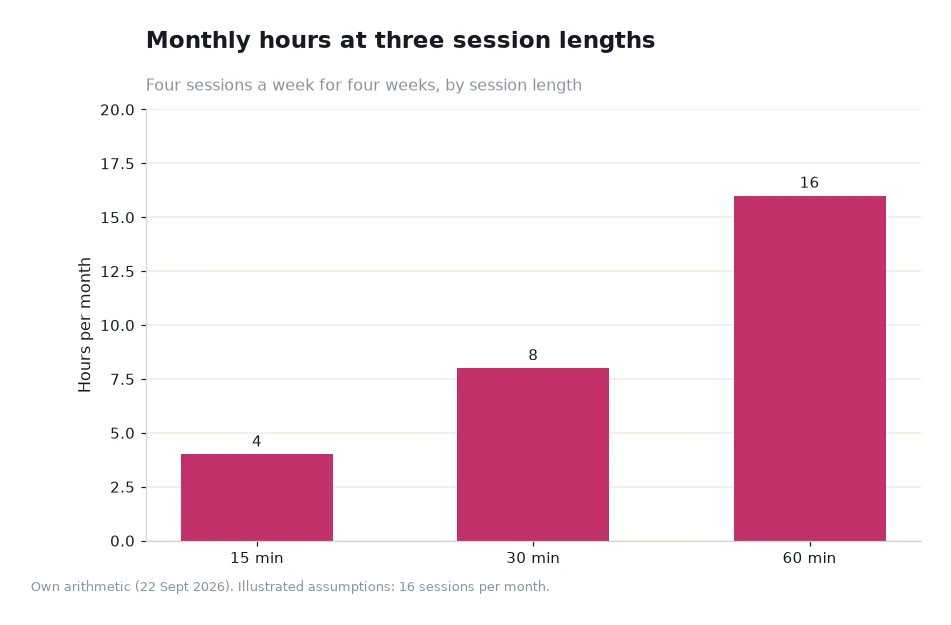
Illustrative assumption: four sessions a week for four weeks, which is 16 sessions in a month. At 15 minutes each, that is 16 × 15 = 240 minutes, or 4 hours. At 30 minutes each it is 480 minutes, or 8 hours. At 60 minutes each it is 960 minutes, or 16 hours.
Now weigh what those hours contain. A 30-minute session in which you spend the first two minutes setting the register and the remaining 28 following it forward delivers far more usable signal than one long session spent circling the same generic opening. The same 8 hours of monthly contact, spread over 16 visits rather than four, gives the retained preferences twelve additional opportunities to be applied and corrected. That is arithmetic you can run on your own habits: sessions per week × minutes × 4.
Getting the most from an ai sex chat setup
Treat the first two minutes of every session as setup rather than small talk. State the register, the pacing and anything you want carried forward, then let the conversation run. Over a month of 16 sessions that convention costs about 32 minutes, which is 32 ÷ 480 = 6.7% of an 8-hour month — a small tax for a large improvement in how consistent the replies feel.
It also helps to keep a note of what you told a character and when. If a preference stops being reflected, the fastest fix is to restate it once, clearly, instead of rephrasing it repeatedly across a session. Readers who want to see the platform's own wording rather than a paraphrase can check the AI chat blog, which is where feature explanations are published.
Frequently asked questions
Does the system learn my personality automatically?
Not in the way that phrase suggests. It works from what you write and from preferences it retains between conversations, and the platform describes the outcome as adaptation to your personality and memory of your preferences.
How many sessions does it take before replies feel tailored?
Register and pacing usually settle inside the first session or two. Anything carried across visits needs a second and third visit to be visible, which is why 16 short sessions a month tends to show more change than four long ones.
Can a companion remember something from months ago?
Characters are described as recalling previous interactions, so earlier conversations can inform later ones. Where a detail matters to you, restating it once is the reliable move rather than assuming it is still in view.
Set the loop up once and keep feeding it
Spend two minutes per session stating what you want, keep the phrasing stable, choose a character whose premise already fits, and let the retained preferences do the work across visits. Adaptation is unglamorous when described honestly — it reflects the detail you supply — and that honesty is exactly what makes it predictable enough to plan around.
Data and sources: Crushon's AI sex chat page[1] for the adaptation and memory wording, the porn chat page FAQ[2] for the note that some limitations apply under the content and community guidelines, read 22 Sept 2026. Session-hour figures are illustrative arithmetic on 16 sessions per month. Audience: adults 18 or older.