84 Strands, 6 mm Diameter: A 6 mm² Conductor in Detail
Eighty-four strands of 0.29 mm bunched inside a 6.0 mm jacket is the published shape of a 6 mm² PV conductor, and the KUKA CABLE product page for that size carries more electrical detail than any other page on the site. It lists DC 1.8/1.8 kV, a 10 kV spark test in production, a 6.5 kV AC test for five minutes on the finished drum, and short-circuit limits of +120 °C for 20,000 hours and +250 °C for five seconds.
Key takeaways
- The 6 mm² construction is 84 strands of 0.29 mm with a nominal overall diameter of 6.0 mm.
- Conductor material is tinned copper, class 5 flexible to IEC 60228; insulation and sheath are XLPO, electron-beam cross-linked and LSHF.
- Published electrical data includes DC 1.8/1.8 kV, a 10 kV spark test and a 6.5 kV AC test for five minutes.
- Mechanical data includes tensile strength of at least 8 N/mm², elongation of at least 125%, and 78 g per metre of finished cable.
The 6 mm² construction line by line
A 6 mm² conductor is built from 84 wires of 0.29 mm, tinned before stranding and bunched so the bundle behaves as a single flexible core. As with the smaller size, the strand count is high for the metal volume, and that is the point: flexibility comes from distributing strain across many thin wires. The tinning protects each wire against corrosion and gives the crimp a stable surface to bite into.
The two layers around it are both XLPO, described on the product page as electron-beam cross-linked and LSHF. Colour is black or red. Cross-linking is what separates this from a thermoplastic sheath that softens again when it gets hot, and the low-smoke halogen-free description is aimed at what happens if a fault ever exposes the compound to flame.
What the 1500 V page publishes
The electrical and mechanical list for this design is unusually complete for a product page, which makes it the natural place to check a datasheet against a claim. The values sit together on one page and can be read as a set.
- Rated voltage: DC 1.8/1.8 kV.
- Spark test during production: 10 kV.
- Pressure test on finished cable: 6.5 kV AC at 50 Hz for five minutes.
- Short-circuit temperature: +120 °C sustained over 20,000 hours, then +250 °C for five seconds.
- Tensile strength before ageing: at least 8 N/mm²; elongation before ageing: at least 125%.
- Ambient range: −40 °C to +90 °C; bending radius: four times the outer diameter.
Three standards are named for the same design: TUV 2PfG 1169/08.2007, EN 50618:2014 and IEC 62930. A buyer comparing drums from two suppliers can put those six lines side by side and see immediately which product has published the values and which has not.
Diameter and weight in context
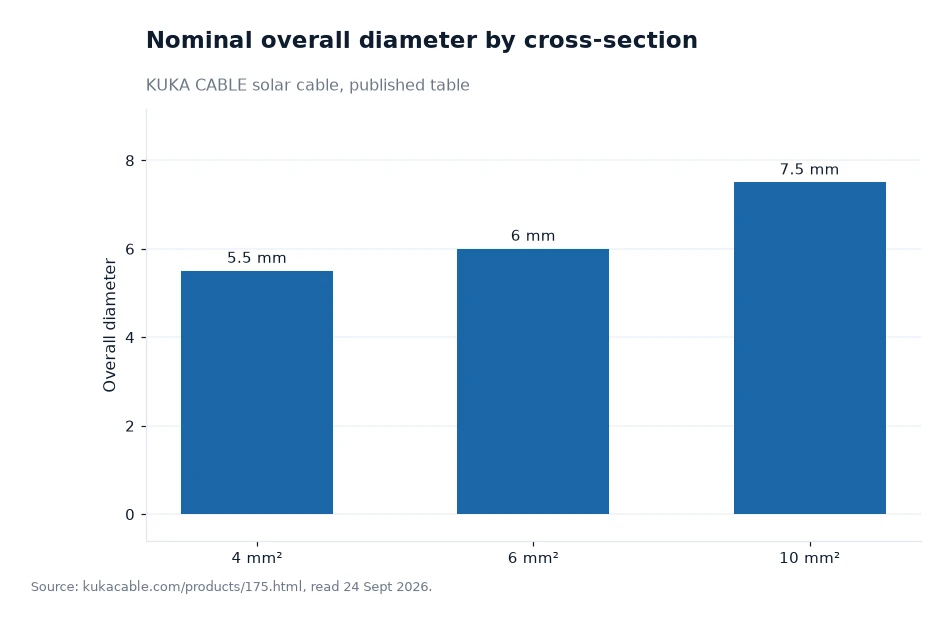
The nominal overall diameter of 6.0 mm sits between the 5.5 mm of the 4 mm² size and the 7.5 mm of the 10 mm² size on the published table. Weight follows the same order: 78 g per metre here, against 59 g/m and 130 g/m for the smaller and larger sizes. The difference of half a millimetre in diameter between 4 mm² and 6 mm² looks small on a drawing and changes the bend floor from about 22 mm to about 24 mm once the published factor of four is applied, which is my own arithmetic on the printed figures.
This is also the size where the case for moving up from 4 mm² is usually made on mechanical rather than electrical grounds: a slightly larger bundle is easier to dress, holds its shape on a rail, and takes a crimp with less risk of a strand being lost during stripping. Whether the extra weight matters depends on the drum length, and that is not published for any size on the site.
Why the middle size suits so many roofs
The maker's site names 4 mm², 6 mm² and 10 mm² as the commonly used specifications, and the PV division has operated independently since August 2018, with the solar range covered by TUV, SAA, CPR and other certifications. A 6mm solar cable is the middle of that standard set, which makes it the default answer on many string layouts and the size most often quoted in a bill of materials.
The published service expectation for these cables is 25 years or more, with one product page stating an expected service life of 30 years. Those are the maker's own statements, and they are worth reading alongside the test evidence: a 2,000-hour xenon lamp run, equal to about 360 weathering cycles, and a vertical flame test in which a single cable is exposed to burning at 800 °C for one minute and is expected to self-extinguish.
Published 6 mm² data at a glance
| Property | Published value | Notes |
|---|---|---|
| Conductor | 84 × 0.29 mm tinned copper, class 5 | Cross-section table |
| Rated voltage | DC 1.8/1.8 kV | 1500 V product page |
| Production test | 10 kV spark test | 1500 V product page |
| Finished cable test | 6.5 kV AC, 50 Hz, five minutes | 1500 V product page |
| Weight | 78 g/m nominal | Cross-section table |
| Minimum bend radius | 24 mm (4 × 6.0 mm, author's calculation) | Published rule applied to the table |
Worked example
Check the strand count against the nominal size before accepting a drum. Each 0.29 mm strand has an area of about 0.066 mm², so 84 strands come to roughly 5.55 mm² of copper. That is my calculation, assuming round strands of the diameter the table gives. The shortfall against the nominal 6 mm² is the space between round wires, and it is normal in a flexible class 5 conductor rather than a sign of a thin product.
The second sum is the bend floor: four times the 6.0 mm diameter gives 24 mm, against 22 mm at 4 mm² and 30 mm at 10 mm². Again, that is my own multiplication of two published numbers. A drawing office that has already set a 20 mm corner radius for a mixed installation will find that only the smallest of the three sizes passes it.
Frequently asked questions
What does the 1500 V product page say about a 6 mm² cable?
It lists the conductor as 84 strands of 0.29 mm of tinned copper, class 5 flexible to IEC 60228, with XLPO insulation and sheath that are electron-beam cross-linked and LSHF in black or red. The rating is DC 1.8/1.8 kV, with a 10 kV spark test in production and a 6.5 kV AC test for five minutes on the finished cable.
Is a 6 mm² PV cable heavy enough to need special support?
At a published 78 g per metre, a 200 m length weighs around 15.6 kg by my own multiplication of the two numbers. That is a two-person lift rather than a machine lift, but the load on a mounting rail matters more than the drum weight, so spacing and clamping should be part of the design. Drum lengths are not published on the site, so ask the supplier for the weight per drum you are ordering.
Checks before the order is placed
Confirm the conductor class and strand construction in writing, then compare the rated voltage, the spark and pressure test values and the temperature limits with the design you are building. Ask for the tensile and elongation figures for the batch, since the published floor of at least 8 N/mm² and at least 125% is a requirement rather than a measurement. Where the site is silent, such as on price, minimum quantity and delivery, ask the supplier directly. The solar cable section and the cross-section table hold the published values this article quotes.
Values for the 6 mm² conductor detailed above were taken from the manufacturer's own website and dated 24 Sept 2026[1].